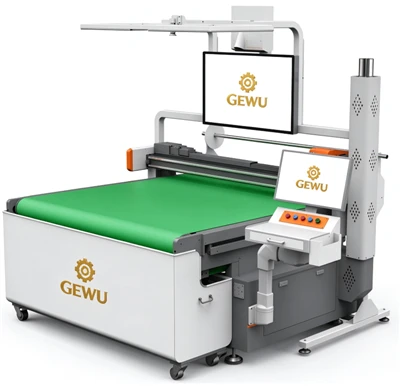
7 Key Factors to Consider Before Buying a Shoe Material Cutting Machine
Investing in a shoe material cutting machine is not simply a matter of comparing speed, price, and table size. Factories that rush into a purchase based only on brochure specifications often discover hidden problems months later-materials that won't hold flat, patterns that don't match across left and right parts, or a nesting system that leaves expensive leather on the cutting table as waste. The factors that determine whether a machine delivers long-term value are often the ones sales presentations gloss over.
1. Controller and System Architecture
The controller is the heart of the cutting machine-not its weight or appearance. A well-designed controller system determines cutting stability, precision, and the machine's ability to adapt to future production needs.
When evaluating controller architecture, consider where the control system is installed. If the controller runs on a standard PC, it competes for CPU resources and may lag under heavy workloads or complex nesting operations. The ideal configuration places the controller in a separate, dedicated cabinet, ensuring stable and continuous operation regardless of the cutting complexity .
An independently developed control system also offers advantages for customization. If your factory requires specific functions-unusual material profiles, specialized nesting rules, or integration with existing CAD workflows-a proprietary controller platform is easier to modify and support than a generic PC-based system .
2. Knife Head Quality and Tool Compatibility
The knife head determines cutting quality and material adaptability. Every material behaves differently under the blade, and a machine that excels on leather may fail on EVA foam or dense rubber without the correct tooling.
When inspecting the knife head, pay attention to motor speed and dynamic balance. Typical oscillation frequencies range from 13,000 to 18,000 RPM. A well-balanced knife head runs smoothly and quietly; excessive noise or vibration indicates poor dynamic balance, which can damage both the machine and the material being cut .
A practical field test: power on the knife head and observe its movement. If the blade moves side to side noticeably, the balance is poor. Slight or no lateral movement indicates good quality . Blade quality matters equally-carbide blades retain sharpness longer and produce cleaner edges on leather and synthetic materials .
Different materials require different tool families. An oscillating knife handles most leather and foam, a circular knife suits woven textiles, and a pneumatic oscillating head is needed for dense rubber or thick composites. A machine that supports multiple tool modules without requiring a separate machine for each material type offers better long-term versatility .
3. Vacuum Adsorption System: More Than Just "Having" It
Precision cutting depends on material stability. If the material shifts during cutting-especially at curves, corners, and small features-the resulting parts will be inconsistent, and left/right pairs may not match.
Vacuum adsorption is the standard method for holding flexible materials during CNC cutting. But the presence of a vacuum system is not enough. The relevant questions are: How strong is the actual negative pressure at the cutting surface? Is the table divided into zones so that small parts or partial material layouts can still be held securely? And what happens when the material becomes smaller as cutting progresses-does the remaining material still stay flat ?
For genuine leather, which is irregular in shape and may curl or have varying thickness, the vacuum system must be capable of holding the entire hide, not just the center. Testing with real production material-not a flat, regular sample-reveals whether the adsorption system performs under actual working conditions .
4. Visual Recognition and Defect Marking
For factories cutting genuine leather, material utilization is often the single largest cost factor. Every square centimeter of leather saved per hide translates directly into reduced material cost per pair of shoes.
Visual recognition systems use cameras to capture the outline of each hide, identify defects and quality variations, and feed this information to the nesting software. The system should be able to detect not only the hide boundary but also interior defects-scars, holes, and areas of inconsistent color or texture .
But detection alone is not enough. The software must also allow operators to assign quality zones: visible upper panels may require defect-free leather, while internal components can use lower-grade areas. A visual system that identifies defects but cannot enforce quality-zone rules during nesting provides limited practical value .
5. Nesting Software and Material Utilization
Nesting software determines how efficiently patterns are arranged on the material. For leather cutting, this is not simply about fitting shapes tightly-it is about avoiding defects, respecting grain direction, and ensuring that left and right parts are oriented correctly.
A capable nesting system should support automatic layout with defect avoidance, automatic identification of holes and internal features, and intelligent parameter coding for different production runs . When comparing machines, avoid judging nesting software by a single demonstration. Instead, test it with your own production patterns-the ones with tight curves, small holes, notches, and left/right pairs that must match exactly .
Material savings claims from automated nesting typically range from 3% to 10% compared to manual layout, depending on the complexity of the patterns and the consistency of the material . For a factory processing thousands of hides per year, even a 5% improvement represents a significant cost reduction.
6. Material Compatibility and Tool Selection
A shoe material cutting machine must handle the full range of materials your factory processes. Leather, PU synthetic, microfiber, EVA foam, mesh fabric, and rubber each have different cutting characteristics.
Dense sole material does not behave like thin synthetic upper material. A supplier should be able to explain why a particular tool was selected for your material and demonstrate the cutting result on your actual production samples, not just a demonstration piece .
When requesting a machine recommendation, provide specific information: What materials will be cut? Are they rolled or sheet form? What is the thickness range? Do you need punching, marking, or drawing functions in addition to cutting? Vague inquiries like "leather cutting machine" often result in recommendations that do not match actual production needs .
7. Brand Support and After-Sales Service
A cutting machine is a long-term production asset. When it breaks down, production stops. The availability of spare parts, technical support, and service response time directly affects your factory's ability to meet delivery schedules.
Before purchasing, verify that the manufacturer has a stable support infrastructure. Common problems reported by factories include machines breaking down with no way to contact the original manufacturer, obsolete models with no available replacement parts, and difficulty getting responses from suppliers after the sale .
Practical checks include: Does the manufacturer stock common spare parts? Is there a local service representative or distributor? What is the typical response time for technical issues? Can the manufacturer provide references from factories using the same machine model for similar applications ?
After-sales support also includes operator training. A well-trained operator can increase a machine's effective output significantly. A 2-day training course is often sufficient for operators with no prior CNC experience to master basic functions, but the quality of that training depends on the manufacturer's commitment to customer success .
Summary
| Factor | What to Verify | Why It Matters |
|---|---|---|
| Controller & System | Separate cabinet, independent development | Stability under heavy workloads, customization potential |
| Knife Head | Motor speed 13,000–18,000 RPM, dynamic balance | Cutting quality, material adaptability, machine longevity |
| Vacuum Adsorption | Zone control, negative pressure with small parts | Material stability at curves and small features |
| Visual Recognition | Defect detection + quality zone assignment | Material utilization for genuine leather |
| Nesting Software | Test with your patterns, defect avoidance | 3–10% material savings, left/right matching |
| Material Compatibility | Tool selection explained and demonstrated | Correct cuts across leather, EVA, foam, fabric |
| Brand & Service | Spare parts availability, local support | Production continuity, long-term ROI |