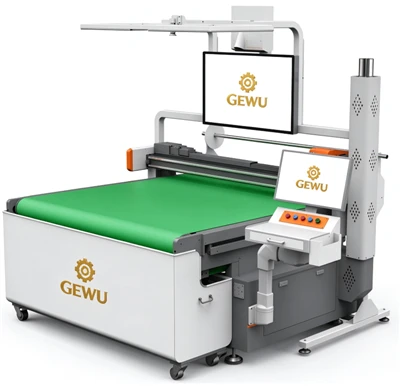
How to Improve Cutting Precision with Your Shoe Material Cutting Machine
Cutting precision in footwear manufacturing is not a single machine setting-it is the cumulative result of material behavior, mechanical stability, tool condition, and process discipline. A machine that cuts with ±0.05mm accuracy on a specification sheet may produce parts with visible deviations in actual production if any one of these factors is neglected. For shoe components produced in left/right pairs and multiple sizes, even small precision losses become assembly problems that surface at the stitching station.
Understanding how to improve precision requires examining where accuracy is actually lost, then addressing each source systematically.
Understanding Why EVA and Soft Materials Lose Precision
EVA foam and similar soft materials behave differently under a cutting blade than rigid materials. The blade does not simply separate the material-it first compresses it, then cuts through . If the blade is not sharp enough or the cutting depth is set incorrectly, the material is flattened before being cut, resulting in beveled edges and undersized dimensions .
This compression-and-release behavior means precision is lost before the cut even begins. The material's elastic recovery after the blade passes can pull the cut edge away from the intended path. For EVA materials specifically, density distribution within a single sheet is rarely uniform, so the actual thickness at different locations may vary from the nominal value .
The Role of Vacuum Adsorption in Maintaining Position
Material movement during cutting is one of the most common causes of precision loss. When vacuum adsorption is insufficient, the material shifts as the blade contacts it, especially at curves and corners where lateral forces are highest.
A properly configured vacuum system holds the material flat and stationary throughout the cutting path. Research on EVA cutting indicates that full vacuum adsorption is the primary method for preventing material displacement during cutting . For machines processing foam and flexible materials, the vacuum system's ability to maintain consistent negative pressure across the entire work area directly determines whether cut dimensions remain within tolerance .
If suction weakens in certain zones, or if the vacuum table cannot adapt to varying material sizes as cutting progresses, the material will move. Zone-controlled adsorption systems address this by allowing suction to be concentrated only where material is present, improving holding force on small or irregularly shaped workpieces .
Cutting Depth Calibration for Actual Material Thickness
Setting cutting depth based on nominal material thickness is a common error. Because EVA and foam materials have density variations that affect actual thickness, the cutting depth should be calibrated based on measured values rather than the specification sheet .
For multilayer cutting, attempting to cut through thick materials in a single pass increases lateral forces on the blade, which can cause the cut to deviate from perpendicular. Cutting in multiple layers or passes reduces these forces and helps maintain dimensional accuracy .
Tool Sharpness and Blade Selection
A dull blade on EVA does not simply cut less efficiently-it produces geometrically different results. The compression-then-cut mechanism means that a dull blade flattens the material more before penetrating, creating a wider deviation between intended and actual cut lines .
Blade selection also matters for precision. For EVA of different thicknesses, the appropriate tool varies: vibrating knives for thin to medium materials, and milling modules for thicker materials or where grooves and layered cutting are required . High-speed steel and carbide blades both work, but the critical factor is maintaining sharpness-the effect of a dull blade is more pronounced on EVA than on harder materials .
Mechanical Stability and Maintenance
Machine precision degrades over time without maintenance. The guide rails and racks that position the cutting head develop gaps as they wear, and these gaps translate directly into cutting errors . Weekly application of grease to guide rails and racks helps maintain the tight tolerances required for accurate positioning .
Belt tension affects motion accuracy. Uneven belt tension causes the X-axis and Y-axis to move at mismatched ratios, producing irregular shapes and cuts that do not close properly . The coupling between motors and lead screws can loosen over time, introducing backlash that manifests as incomplete cut closure .
The cutting table itself can contribute to precision loss. The felt surface degrades with use, becoming uneven. Modern control systems offer dynamic compensation functions that adjust the Z-axis based on measured table flatness, but this requires periodic calibration to remain effective .
Material-Specific Strategies for Precision
Different shoe materials require different precision approaches.
For leather and high-elastic fabrics: Enable overcut compensation in the software and calibrate it against actual test cuts. If test circles consistently measure smaller than intended, apply tool radius compensation or contour expansion to correct for material recovery . For small parts, leave uncut connection tabs to prevent the pieces from shifting into the waste skeleton after separation .
For thick EVA and rubber: Follow the principle of cutting internal features before external contours. This keeps the material body firmly held by vacuum suction while internal details are cut, preventing the part from moving as the outer boundary is released .
For multi-layer cutting: Inter-layer slippage is a common precision problem. Without a deviation correction system, the bottom layers can shift relative to the top even when the top layer appears aligned . Automatic deviation correction systems using photoelectric sensors can detect and compensate for lateral drift during feeding, maintaining alignment across the entire material stack .
Process Control and Consistency
Precision is not achieved once and then maintained automatically. It requires process discipline.
Cutting parameters should be saved as independent templates for different materials and part types. This prevents accidental modification of oscillation amplitude, speed, and cutting depth between production runs .
Batch consistency matters for paired components. Left and right shoe parts must match exactly. If parameters are adjusted mid-batch, even if the adjustment improves individual piece quality, the batch will contain mismatched pairs that cannot be assembled. The guidance for EVA cutting is clear: do not change parameters within the same production batch .
When Vision Systems Help
For printed materials or operations requiring alignment to existing features, vision systems can compensate for material deformation and positioning errors. Mark point detection systems achieve positioning accuracy within 0.1mm by locating predefined reference markers on the material . Feature recognition systems are more flexible, automatically adapting to material shifts and deformation during processing .
These systems are most valuable when cutting pre-printed uppers, when material shrinkage or stretch introduces cumulative positioning errors, or when the cutting pattern must align with decorative elements already present on the material.
Summary
| Precision Factor | What to Check | Action |
|---|---|---|
| Material compression | Blade sharpness, cutting depth | Calibrate depth to measured thickness; replace dull blades |
| Material movement | Vacuum suction strength, zone coverage | Verify negative pressure; clean vacuum pipes and filters |
| Mechanical wear | Guide rail gaps, belt tension | Apply grease weekly; replace worn belts |
| Table flatness | Uneven cutting depth across work area | Run dynamic compensation calibration |
| Multi-layer slippage | Layer alignment during feeding | Consider auto deviation correction system |
| Batch consistency | Parameters unchanged during production | Save parameter templates per material; no mid-batch adjustments |
Cutting precision is maintained through attention to the material, the machine, and the process. A machine with high rated accuracy will still produce poor results if the material shifts, the blade is dull, or the parameters are changed mid-batch. The factors that most influence precision are often not in the machine's specification-they are in the daily discipline of how it is maintained and operated.