What Is a Heel Forming Machine in Shoemaking
A heel forming machine is a piece of footwear manufacturing equipment that shapes the heel seat area of a shoe upper before the shoe is lasted. It is used in the production of men's shoes, women's shoes, children's shoes, boots, and other footwear types where the heel counter must conform precisely to the last.
The machine's job is simple to describe but difficult to achieve by hand: it takes the flat or partially formed heel area of the upper and shapes it into a three-dimensional form that matches the contours of the shoe last. The result is a heel seat that holds its shape, fits the wearer's heel correctly, and provides a stable foundation for the rest of the shoe.

Why Heel Forming Matters in Shoemaking
The heel seat is one of the most structurally important areas of a shoe. It determines how well the shoe grips the wearer's heel, how comfortable it feels during walking, and how well it retains its shape over time. If the heel seat is not formed correctly, the finished shoe may slip at the heel, collapse at the back, or develop wrinkles and creases that affect both appearance and fit.
Beyond fit and comfort, the heel seat also affects the shoe's durability. A heel seat that is not properly bonded may separate from the upper during wear, causing the heel counter to lose its shape and the shoe to become unstable. For safety footwear, a poorly formed heel seat can affect the alignment of the entire shoe, potentially compromising the protective performance of the toe cap and sole.
In traditional shoemaking, the heel seat was formed by hand using a hammer and a forming block. The operator would moisten the upper, place it over the last, and manually work the material into the heel seat shape. This method is still used in some small workshops, but it is slow, depends heavily on operator skill, and produces inconsistent results across a production batch. The quality of the finished heel seat varies from shoe to shoe, and the physical demands of manual forming limit how much one operator can produce in a shift.
A heel forming machine replaces this manual process with a controlled, repeatable operation. The machine applies heat, pressure, and cooling in a defined sequence to shape the heel seat and set the form. The result is a consistent heel seat across every pair, regardless of operator skill or fatigue.
The Working Principle of a Heel Forming Machine
Although designs vary between manufacturers, most heel forming machines operate on the same basic principle: they combine heat to soften the upper material, pressure to shape it against the last, and cooling to set the form.
The process typically follows this sequence:
Loading. The shoe upper is placed over the last or positioned in a holding fixture. The heel seat area is aligned with the forming head. On machines with air bag wrapping, the last is wrapped in an air bag so that the shoe bag is tighter and more uniformly against the last.
Hot forming. A heated forming head applies pressure to the heel seat area. The heat softens the upper material and the thermoplastic counter, allowing them to conform to the last shape. On machines with independent hot and cold heads, the temperature and pressure of the hot head can be adjusted for different materials. Temperature, pressure, and setting time are all adjustable to suit different upper materials and different temperature settings needed.
Cold setting. The formed heel seat is transferred to a cold head where pressure is applied without heat. This holds the shape while the material cools and sets. Some machines use an environment-friendly freezing system that reaches -15°C after 10 minutes of running to set the shape rapidly. Others use a non-frozen liquid circulation cooling system, which makes forming quickly fixing, evenly, and fine looking on the heel seat section.
Unloading. The formed upper is removed from the machine. The heel seat now holds the shape imparted by the forming heads, ready for the lasting operation.
Key Components
A heel forming machine consists of several key components that work together to deliver the forming operation:
| Component | Function |
|---|---|
| Forming head (hot) | Applies heat and pressure to shape the heel seat |
| Forming head (cold) | Applies pressure without heat to set the shape |
| Holding fixture | Positions the upper and last in the correct orientation |
| Air bag or forming die | Transmits pressure uniformly to the heel seat surface |
| Control system | Manages temperature, pressure, and forming time |
| Cooling system | Provides the cold medium for setting the shape |
The control system is a critical component. On modern machines, it uses a smart computer screen that allows the operator to set and monitor temperature, pressure, and forming time for each station. The machine automatically sleeps under standby mode, resulting in outstanding energy conservation. It is also easy to operate and understand, reducing the training time required for new operators.
Types of Heel Forming Machines
Heel forming machines vary in configuration depending on the production requirements they are designed to meet.
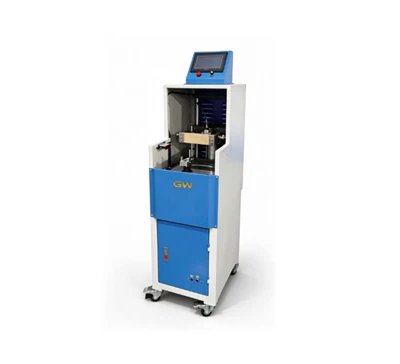
Single-station machines combine hot and cold forming in one station, using a heating phase followed by a cooling phase. These are compact and suitable for small to medium production volumes.
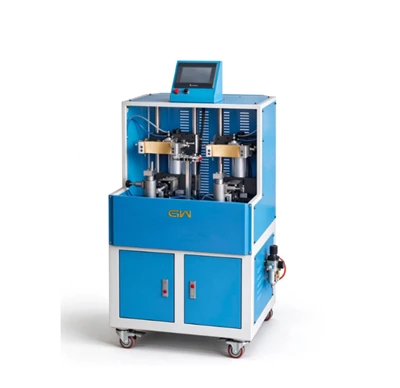
Dual-station machines have separate hot and cold stations. The upper is formed at the hot station, then transferred to the cold station for setting. This configuration is faster because the hot station can be loaded while the cold station is setting a previous upper.
Dual-operator machines allow two people to operate at the same time, which increases working efficiency. These machines are designed for higher-volume production lines where throughput is a priority.
Dual-head machines have two hot heads and two cold heads (or two forming heads of each type), allowing parallel processing of multiple uppers. This configuration delivers the highest throughput per machine and is used in factories producing thousands of pairs per shift.
Some machines also feature independent control over the cold and hot head. This allows the operator to set different parameters for each head, accommodating upper materials that require different forming and setting temperatures. For example, a thick leather upper may need a higher hot-forming temperature and a longer cold-setting time than a thin synthetic upper.
What to Look for in a Heel Forming Machine
When selecting a heel forming machine, several factors determine whether the machine will meet production requirements.
| Factor | What to Consider |
|---|---|
| Capacity | Match pairs per hour to your line speed; typical range is 2,000–2,500 pairs per 8 hours |
| Temperature control | Adjustable temperature for different upper materials and counter types |
| Pressure control | Adjustable pressure for different materials and forming depths |
| Forming time | Adjustable setting time for different upper thicknesses |
| Hot/cold head configuration | Independent or combined control depending on material requirements |
| Air bag or die system | Air bag wrapping for uniform pressure; die system for specific shapes |
| Operator capacity | Single or dual-operator design to match available labor |
| Energy features | Auto-sleep and convection cooling reduce operating costs |
| Floor space | Machine dimensions must fit your production area |
Applications in Footwear Manufacturing
Heel forming machines are used wherever the heel seat must be shaped before lasting. Common applications include:
Men's shoes - shaping the heel seat for dress shoes, casual shoes, and work shoes.
Women's shoes - forming the heel seat for pumps, flats, and boots.
Children's shoes - shaping smaller heel seats with the same precision as adult footwear.
Boots - forming the heel seat for ankle boots, riding boots, and tall boots.
Safety shoes - preparing the heel seat for reinforced heel counters used in protective footwear.
In each application, the machine delivers the same benefit: a heel seat that is shaped consistently, holds its form through lasting, and provides the fit and structure the finished shoe requires.
Common Problems Solved by Heel Forming Machines
Manufacturers invest in heel forming machines to solve specific production problems that manual or low-capacity methods cannot address.
Inconsistent heel seat shape. Manual forming depends on operator skill, and even experienced operators produce variation across a shift. The machine delivers the same shape every cycle.
Wrinkles and deformation. Improperly formed heel seats develop wrinkles and creases that affect appearance and fit. The machine applies uniform pressure and heat to eliminate these defects.
Weak bonding between layers. The heel seat area typically includes the upper, lining, and thermoplastic counter. If these layers are not bonded closely, the heel seat may separate during wear. The machine presses the layers together under heat and pressure, ensuring a close bond.
Slow production. Manual forming is slow and limits throughput. The machine processes 2,000–2,500 pairs per 8 hours, keeping pace with modern production lines.
High labor cost. Manual forming requires skilled operators and significant labor time. The machine reduces the labor content per pair and allows less-skilled operators to produce consistent results.
Maintenance and Operation
A heel forming machine requires regular maintenance to deliver consistent results. Key maintenance tasks include:
Cleaning the forming heads to remove residue from upper materials and adhesives.
Checking the air bag or forming die for wear or damage.
Verifying temperature calibration to ensure the hot head reaches the set temperature.
Inspecting the cooling system to maintain consistent cold-setting performance.
Lubricating moving parts according to the manufacturer's schedule.
Operators should be trained on the correct loading procedure, parameter settings for different shoe types, and safe operation of the hot and cold stations. Modern machines with smart computer screens make this training straightforward.
Summary
A heel forming machine is a shoemaking machine that shapes the heel seat area of a shoe upper before lasting. It combines heat, pressure, and cooling in a controlled sequence to form the heel seat against the shoe last and set the shape. The machine replaces manual heel forming with a repeatable process that delivers consistent quality across the production batch, solving common problems such as inconsistent shape, wrinkles, weak bonding, and slow production.
For footwear manufacturers producing shoes at volume, the heel forming machine is a key piece of equipment for ensuring proper heel fit, appearance, and structural integrity. Understanding what the machine does, how it works, and what to look for when selecting one helps manufacturers make informed decisions about their production equipment.